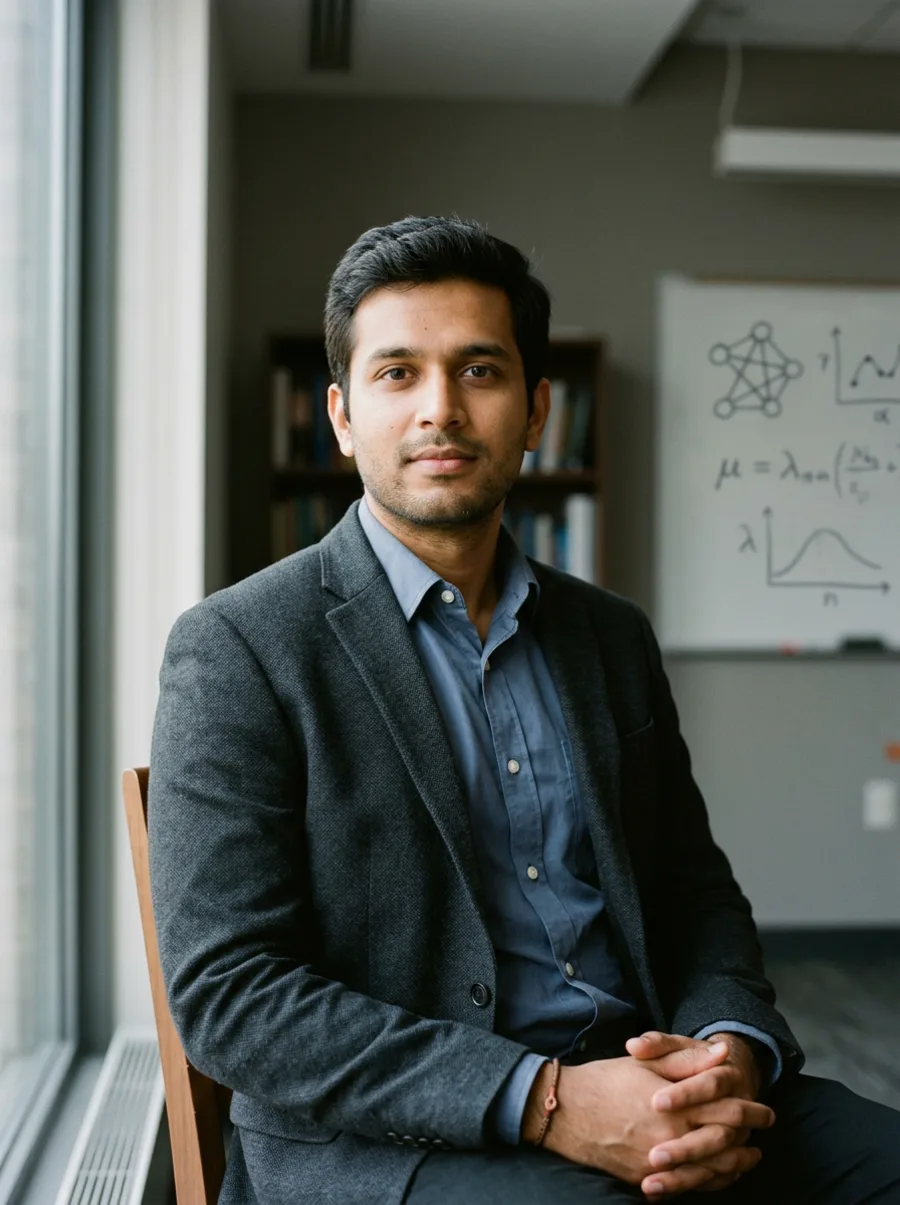
Portrait of Dr. Aarav Mehta Published Academic Profile

Doctoral Achievement

Dr. Aarav Mehta, PhD

Research Scientist & Academic

PhD in Artificial Intelligence

Institution

University of Oxford

Location

London, United Kingdom

Published

September 07, 2026

Publication ID

ATR-2026-00488

Credential status

Credential Provided

01 · Introduction

Academic journey

Aarav Mehta studied computer science at IIT Delhi, took a master's at Imperial College London, and completed his doctorate at Oxford in 2026. His subject is the formal verification of learned components — the problem of establishing, with proof rather than testing, that a machine learning system will not enter a specified unsafe region of its behaviour space.

The problem matters because learned components have begun to appear in systems where failure is not a matter of degraded service. His doctoral work was conducted partly in collaboration with an industrial partner operating process-control systems, an arrangement that constrained what he could publish and considerably improved what he could learn.

He describes the doctorate as three years of narrowing. The original proposal addressed verification in general; the thesis addresses a specific class of controllers under specific assumptions, and proves something true about them. He regards this as the principal lesson of doctoral training.

He now holds a postdoctoral position and continues to work with the same industrial partner on deployment.


In safety engineering the useful guarantee is negative. Nobody needs to know what the system usually does; they need to know what it cannot do. — Dr. Aarav Mehta · On formal guarantees in machine learning
02 · Qualifications

Academic credentials

2026

PhD in Artificial Intelligence

Formal verification of learned systems

University of Oxford · United Kingdom

2021

MSc Computer Science

Advanced computing

Imperial College London · United Kingdom

2019

B.Tech Computer Science

Indian Institute of Technology Delhi · India

03 · Research

Doctoral research

Research title

Computable Safety Bounds for Learned Controllers in Constrained Industrial Systems

Abstract

The thesis develops a verification framework establishing formal safety bounds for a class of learned control policies, with computational tractability sufficient for industrial-scale systems, and validates the framework on two production process-control deployments.

Problem statement

Learned components are increasingly used in industrial control, but the verification techniques available either do not scale to realistic system sizes or require assumptions that deployed systems violate. Regulatory approval consequently rests on testing evidence, which cannot establish the absence of unsafe behaviour.

Research methodology

The work combines abstract interpretation with a decomposition exploiting structural properties of the controller class, reducing verification cost from exponential to polynomial in the relevant dimension. The framework was implemented and evaluated on synthetic benchmarks and two industrial deployments under a research agreement.

Major findings

Safety bounds were computed for controllers two orders of magnitude larger than previously tractable. On the industrial deployments the bounds obtained were tight enough to support regulatory documentation. A negative result established that the decomposition does not extend to controllers with unbounded recurrent state.

Academic contribution

The thesis makes formal safety verification tractable for an industrially relevant class of learned controllers.

Future applications

The method is in use on two production process-control systems; extension work addresses recurrent architectures.

Supervisor
Prof. Sarah Lindholm
Department
Department of Computer Science
University
University of Oxford
Completion year
2026
04 · Bibliography

Publications

3 works recorded on this profile, as provided or externally referenced.

01

Conference Paper

Computable safety bounds for decomposable learned controllers

Mehta, A., Lindholm, S.

International Conference on Computer Aided Verification, 2025, pp. 142–164

02

Journal Article

Abstract interpretation for industrial process control policies

Mehta, A., Lindholm, S., Abiodun, T.

Formal Methods in System Design, 2026, Vol. 68, No. 1, pp. 1–29

03

Conference Paper

A negative result on recurrent controller decomposition

Mehta, A.

Workshop on Verification of Neural Networks, 2025, pp. 7–14

05 · Recognition

Achievements & recognitions

Academic Award

Best Paper Award

International Conference on Computer Aided Verification · 2025 · International

For the work on computable safety bounds.

Scholarship

Clarendon Scholarship

University of Oxford · 2022 · United Kingdom

Full doctoral funding award.

Patent

Decomposition method for controller verification

UK Intellectual Property Office · 2026 · United Kingdom

Granted patent, filed jointly with industrial partner.

06 · Measures

Research impact

Figures as submitted or externally referenced at the time of publication. Bibliometric measures vary between indexing services and should be read as indicative rather than definitive.

240

Citations

8

h-index

11

Research Papers

2

Patents

9

Conference Presentations

07 · Practice

Career & professional journey

2026 — Present

Postdoctoral Research Associate

University of Oxford

Oxford, UK

Continuing verification work with the original industrial partner.

2023 — 2026

Research Collaborator

Northgate Process Systems

London, UK

Industrial collaboration under a doctoral research agreement.

08 · Consequence

Impact & contribution

Mehta's verification method has been applied by his industrial partner to two process-control deployments, in each case establishing bounds that permitted regulatory sign-off where testing evidence alone had not. The academic contribution is narrower and more durable: the thesis identifies a class of learned controllers for which safety bounds are computable at practical scale, and provides the tooling to compute them. Two other research groups have since extended the method to adjacent controller classes.

09 · In conversation

Scholar conversation

What drew you to formal verification?

A conviction that testing is not evidence of absence. I came to it from an undergraduate interest in logic, and the appeal was that verification offers a different kind of claim — not that a system usually behaves well, but that it cannot behave badly within stated assumptions. That is a much stronger thing to be able to say.

How did the industrial collaboration shape the work?

Substantially, and mostly by constraining it. My original proposal was about verification in general. Working with a partner who had real deployed systems made it immediately clear which assumptions were unrealistic. Half of the thesis is the result of being told, politely, that something I had assumed was not true of any system they operated.

What was the hardest phase?

The point at which I proved that my method does not extend to recurrent architectures. I had spent four months trying to make it work before I understood that it could not. Writing that up as a negative result rather than quietly dropping it was the right decision, but it did not feel like progress.

What advice would you give future researchers?

Publish the negative results. The field is worse off for the ones that go unpublished, and you will find that people trust the positive results more when they can see what you also tried.

11 · Verification

Credentials & references

ORCID ↗

0000-0000-0000-0003

Credential Provided
Publication Reference
Credential Provided

Basis of this record

Credentials on this profile were provided by the subject or their representative. Independent verification has not been completed. Corrections and updates may be requested at any time via our corrections page.

13 · Citation

Cite this profile

Continue reading

Explore similar profiles

Selected on the basis of research field, institution, qualification and country.

All profiles
The Aeternum Dispatch

New profiles and research writing, once a month

A short editorial letter listing newly published profiles and the research pieces accompanying them. No advertising, no third-party sharing.

By subscribing you agree to our privacy notice.