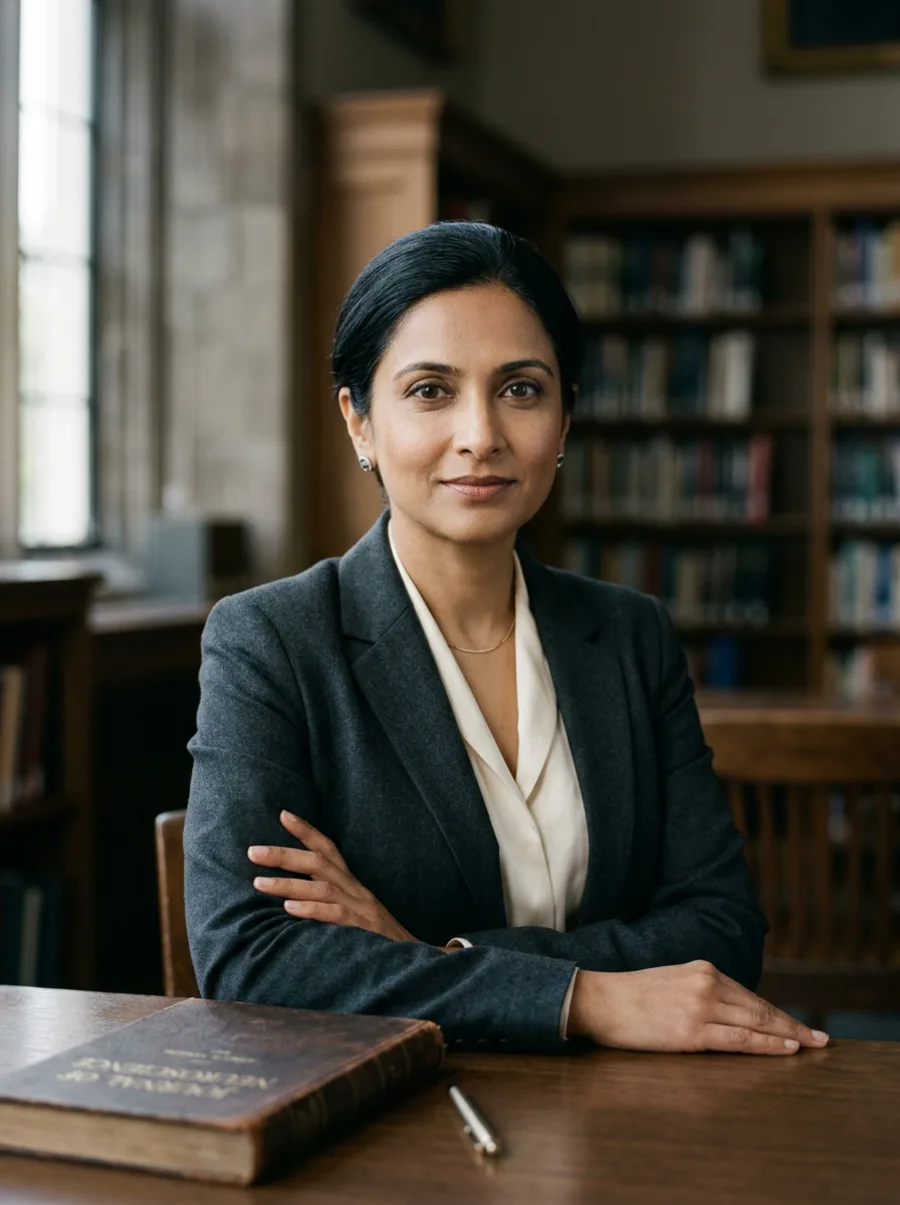
Portrait of Dr. Alexandra Morgan Featured Scholar

Research Excellence

Dr. Alexandra Morgan, PhD, FRSA

Professor of Machine Intelligence

PhD in Artificial Intelligence

Location

Cambridge, Massachusetts, United States

Published

September 01, 2026

Publication ID

ATR-2026-00482

Credential status

Verified

01 · Introduction

Academic journey

Alexandra Morgan did not begin in computer science. She read philosophy at Edinburgh, where a seminar on the epistemology of testimony left her with a question she could not put down: what does it mean to trust a claim you cannot verify? Two decades later, that question has become a research programme spanning machine learning, administrative law and the practical business of auditing systems already in production.

Her route into the field was indirect. After a master's in logic she spent three years as a policy analyst, drafting briefings on automated decision-making for a legislature that had not yet decided whether the subject was technical or constitutional. The experience convinced her that the two vocabularies were not being translated for one another. Engineers were producing accuracy figures; regulators were asking questions about reasons. Nobody was building the bridge.

She returned to doctoral study late, at thirty-one, and completed a PhD on the formal semantics of model explanation. The thesis was unusual in that it contained both proofs and statutes. It argued that the prevailing family of post-hoc explanation methods could not, in principle, support the standard of reasoned decision required by administrative law — and then set out an alternative class of intrinsically interpretable architectures that could.

The argument was contested. It is now largely accepted. In the decade since, Morgan has led the Institutional Intelligence Group, a laboratory that is deliberately half technical and half legal, and which has been engaged by hospital trusts, benefits agencies and two national audit offices to examine systems already making consequential decisions about people.

She teaches a graduate seminar that requires computer scientists to read case law and lawyers to write code. It is heavily oversubscribed.


A model that cannot be interrogated cannot be governed. Interpretability is not a courtesy we extend to users — it is the precondition of accountability. — Dr. Alexandra Morgan · On the relationship between technical method and institutional oversight
02 · Qualifications

Academic credentials

2016

PhD in Artificial Intelligence

Formal semantics of model explanation

Massachusetts Institute of Technology · United States

2011

MSc in Logic and Computation

Mathematical logic

University of Edinburgh · United Kingdom

2007

MA (Hons) Philosophy

Epistemology

University of Edinburgh · United Kingdom

2019

Fellowship, Royal Society of Arts

Royal Society of Arts · United Kingdom

03 · Research

Doctoral research

Research title

Reasoned Decision and Machine Explanation: A Formal Account of Interpretability under Administrative Constraint

Abstract

The thesis addresses a mismatch between the explanatory guarantees offered by contemporary machine learning methods and the standard of reasoned decision required when automated systems are used by public authorities. It develops a formal semantics for model explanation, demonstrates limitations in the post-hoc explanation paradigm, and proposes a class of constrained architectures for which faithful explanation is a structural property rather than an approximation.

Problem statement

Post-hoc explanation methods produce accounts of model behaviour that are locally plausible but not guaranteed faithful to the computation performed. Where a decision carries legal consequence, an unfaithful explanation is worse than no explanation: it satisfies the appearance of accountability while defeating its purpose. No formal framework existed for distinguishing the two cases.

Research methodology

The work combines three methods. First, a formal analysis establishing conditions under which an explanation is faithful to an underlying decision function. Second, a doctrinal review of the reasoned-decision standard across four administrative law traditions, conducted to derive testable requirements. Third, an empirical programme evaluating constrained architectures against unconstrained baselines on three consequential decision datasets, measuring both predictive performance and explanation faithfulness.

Major findings

The analysis established that faithful post-hoc explanation is unattainable for a broad and practically important class of models. Empirically, constrained architectures incurred a predictive cost that was substantially smaller than assumed — on the order of one to three percent on the datasets examined — while providing explanations that were faithful by construction. The doctrinal review found that the reasoned-decision standard is more demanding than most technical treatments of interpretability had recognised.

Academic contribution

The thesis provides the first formal bridge between the technical literature on interpretability and the administrative law standard of reasoned decision, together with an architecture class satisfying both.

Future applications

The methods have been applied to clinical decision support, welfare adjudication review and public-sector procurement standards. Ongoing work extends the framework to sequential and multi-agent decision settings.

Supervisor
Prof. Daniel Whitfield
Department
Department of Electrical Engineering and Computer Science
University
Massachusetts Institute of Technology
Completion year
2016
04 · Bibliography

Publications

5 works recorded on this profile, as provided or externally referenced.

01

Journal Article

Faithful explanation is not attainable for unconstrained decision functions

Morgan, A., Whitfield, D., Osei-Bonsu, K.

Journal of Machine Learning Research, 2024, Vol. 25, No. 118, pp. 1–47

02

Journal Article

Reasoned decision and the audit of automated administrative systems

Morgan, A., Bellweather, J.

Modern Law Review, 2023, Vol. 86, No. 4, pp. 612–658

03

Conference Paper

Intrinsically interpretable architectures for clinical triage support

Morgan, A., Reyes, P., Sundaram, V.

Proceedings of the Conference on Fairness, Accountability and Transparency, 2023, pp. 204–219

04

Book

Machines and Reasons: Interpretability as an Institutional Problem

Morgan, A.

Cambridge University Press, 2025, pp. 412 pp.

05

Research Report

An audit methodology for inherited automated decision systems

Morgan, A., Institutional Intelligence Group

National Audit Working Papers, 2022, pp. 1–88

05 · Recognition

Achievements & recognitions

Fellowship

Fellow, Royal Society of Arts

Royal Society of Arts · 2019 · United Kingdom

Elected in recognition of contribution to public understanding of algorithmic accountability.

Academic Award

Distinguished Paper Award

Conference on Fairness, Accountability and Transparency · 2023 · United States

For work on intrinsically interpretable clinical decision architectures.

Research Grant

Principal Investigator, Institutional Intelligence Programme

National Science Foundation · 2021 · United States

Five-year programme grant supporting interdisciplinary work on automated decision governance.

Patent

Constrained model architecture for auditable inference

United States Patent and Trademark Office · 2022 · United States

Granted patent covering an architecture class supporting faithful explanation by construction.

Speaking Engagement

Keynote, International Conference on Machine Learning

ICML · 2024 · Austria

Invited keynote on interpretability as a design constraint.

Leadership Position

Director, Institutional Intelligence Group

Massachusetts Institute of Technology · 2019 · United States

Founding director of an interdisciplinary laboratory combining machine learning and legal research.

06 · Measures

Research impact

Figures as submitted or externally referenced at the time of publication. Bibliometric measures vary between indexing services and should be read as indicative rather than definitive.

9,840

Citations

47

h-index

112

Research Papers

3

Patents

68

Conference Presentations

24

Students Supervised

19

Research Projects

41

Collaborating Institutions

17

Countries Collaborated

07 · Practice

Career & professional journey

2022 — Present

Professor of Machine Intelligence

Massachusetts Institute of Technology

Cambridge, MA

Directs the Institutional Intelligence Group; teaches a graduate seminar combining machine learning and administrative law.

2017 — 2022

Associate Professor

Massachusetts Institute of Technology

Cambridge, MA

Established the laboratory and its first audit engagements with public bodies.

2016 — 2017

Research Fellow

Alan Turing Institute

London, UK

Postdoctoral work extending the thesis framework to sequential decision settings.

2008 — 2011

Policy Analyst, Technology Committee

Scottish Parliament

Edinburgh, UK

Drafted briefings on automated decision-making in public administration.

08 · Consequence

Impact & contribution

Morgan's central contribution has been to make interpretability a design constraint rather than a diagnostic afterthought. The architectures developed in her laboratory are now used in clinical triage review, where a clinician must be able to state the grounds of a recommendation, and in welfare adjudication, where a claimant has a statutory right to reasons. Her group's published audit methodology has been adopted as a working reference by public bodies examining systems they inherited rather than commissioned. The longer-term consequence is institutional: procurement documents now routinely specify interpretability requirements that did not exist a decade ago.

12 · Record

Publication record

Originally published
September 01, 2026
Last updated
September 04, 2026
Category
Research Excellence
Reference ID
ATR-2026-00482

Editorial review confirms completeness, internal consistency and the presence of supporting references. It is not academic peer review, and the Review does not assess the scientific merit of research described on this profile.

Update history

September 04, 2026

Publication record updated to include the 2025 monograph; research impact figures refreshed from the submitted record.

September 01, 2026

Profile originally published as the September 2026 cover feature.

13 · Citation

Cite this profile

Continue reading

Explore similar profiles

Selected on the basis of research field, institution, qualification and country.

All profiles
The Aeternum Dispatch

New profiles and research writing, once a month

A short editorial letter listing newly published profiles and the research pieces accompanying them. No advertising, no third-party sharing.

By subscribing you agree to our privacy notice.